
Useful Photographs
Dr. Alison Nordström
“I’ve always wanted to be aware of what’s going on around me, and I’ve wanted to use photography as an instrument of research into and reporting on the life of my own time.”
Felicific Calculus is the multilayered result of Eric Kunsman’s observation and research in Rochester, New York. It addresses urban landscapes and how we represent them, but it is also about technology and its changing uses and meanings, and about the dominating visuality of our current culture. As contemporary as it is, it is already a significant historical document. It combines art and science, seeing and interpreting, and the role of information on effecting change. It limns the smallest quotidian details of almost invisible lives, while also speaking to the vast and overarching issues of capitalism, industrialism, racism, and income inequality. It is also very much about photographs, underscoring their inherent slipperiness and the significance of context on how their meanings are determined. It speaks to multiple disciplines: public health, politics, economics, statistics, geography, sociology, and cultural studies, as well as to the complex arenas of art photography, documentation, illustration, evidence, and social justice.
This project began in 2017 as a way to understand and depict the troubled neighborhood in which Kunsman had recently established his studio. It is very much about Rochester, but this city is hardly anomalous. In many ways, Rochester exemplifies the misbegotten American Century, with a character and trajectory that informs our national culture as a whole. This tragic former boomtown is fueled by industrial capitalism at its worst, and flavored by white flight, slowly failing industries, and a city economy unable to tap into the wealth of the smug, affluent communities that surround it. At the end of World War II, Rochester’s Black population numbered less than 7000, but in 20 years had grown to almost 40,000 in a city noted for its strict restrictions against the sale of houses to people of color in most neighborhoods. In the 1950’s, like many urban districts across the country, the predominantly Black inner city was brutally partitioned by the Inner Loop, a circular highway intended to facilitate access to the city from the suburbs, while minimizing the need to move through—or even see---the blighted areas. It continues to isolate poor people damaged further by ongoing job loss, substandard housing, drugs, gangs, and the persistent indifference of the white establishment.
When Kunsman relocated to the challenged and challenging neighborhood of central Rochester, he learned that, for many outsiders, its immediately evident markers of poverty, danger, and otherness went beyond the street corners populated by idle loiterers and the vacant lots where abandoned houses had been bulldozed out of mind. This damning visual landscape was set apart by the presence of public telephones, unusual in other parts of the city. These once neutral fixtures of urban public life were now usually associated with drug dealers, although in fact they remained a vital tool of communication for the often elderly very poor. The confusion around what these once common objects mean today is at the core of this survey. Felicific Calculus is a presentation of Kunsman’s photographic depictions of public telephones as found in their environments, accompanied by graphic interpretations and additional information in the form of maps and statistics.
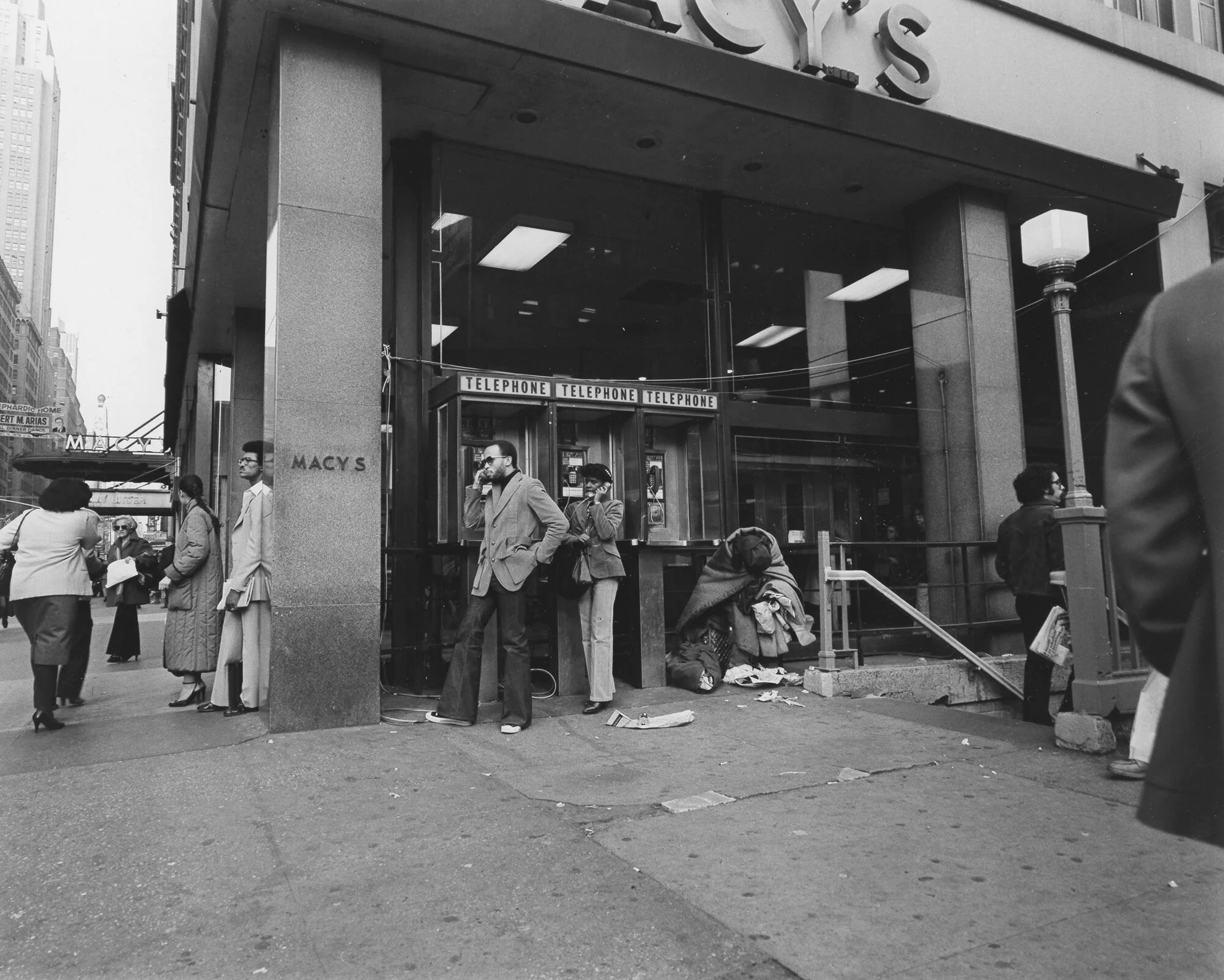
Morris Engel, Phone Booth, Macy’s, 1970’s.
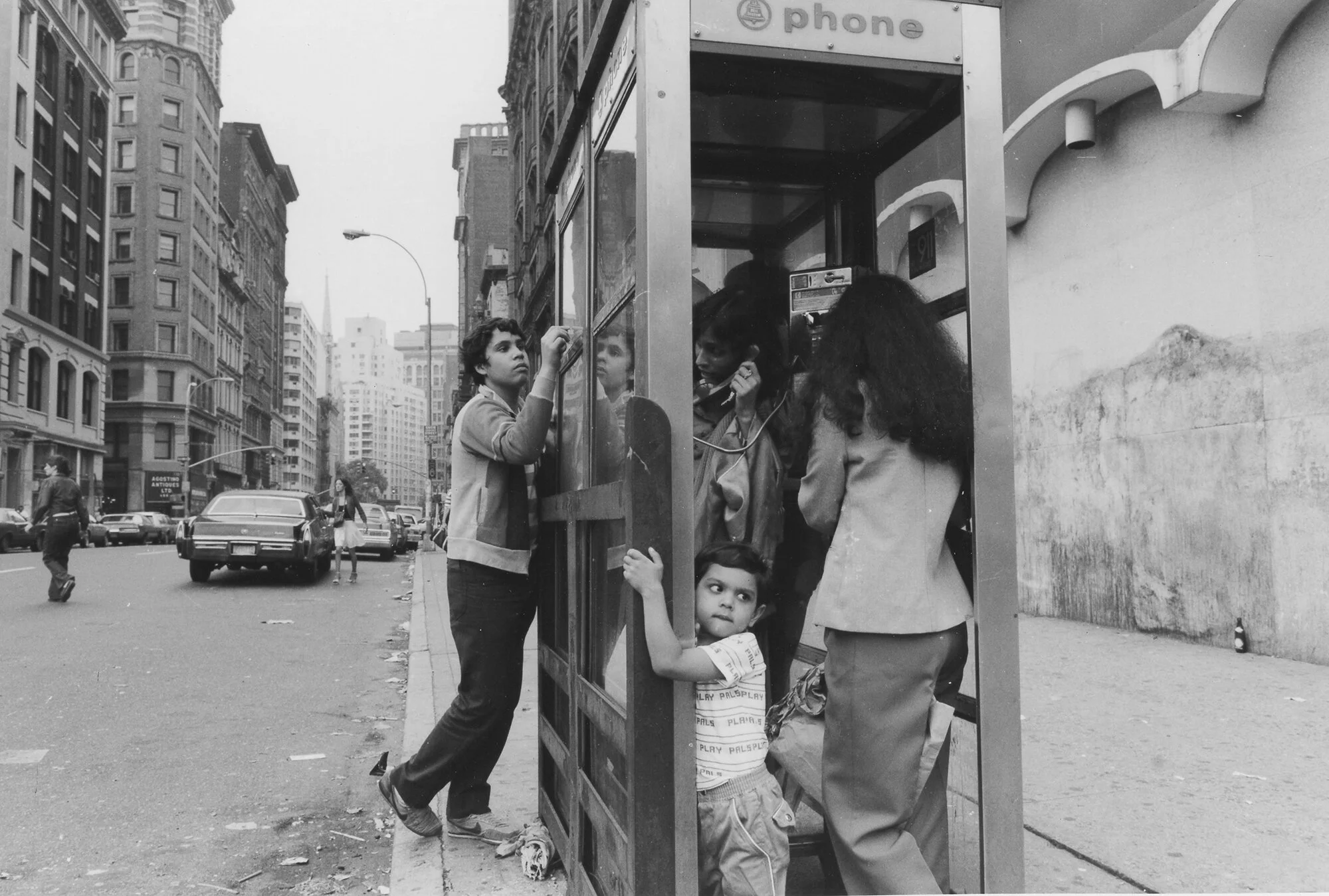
Morris Engel, Phone Booth, Family, 1970’s.
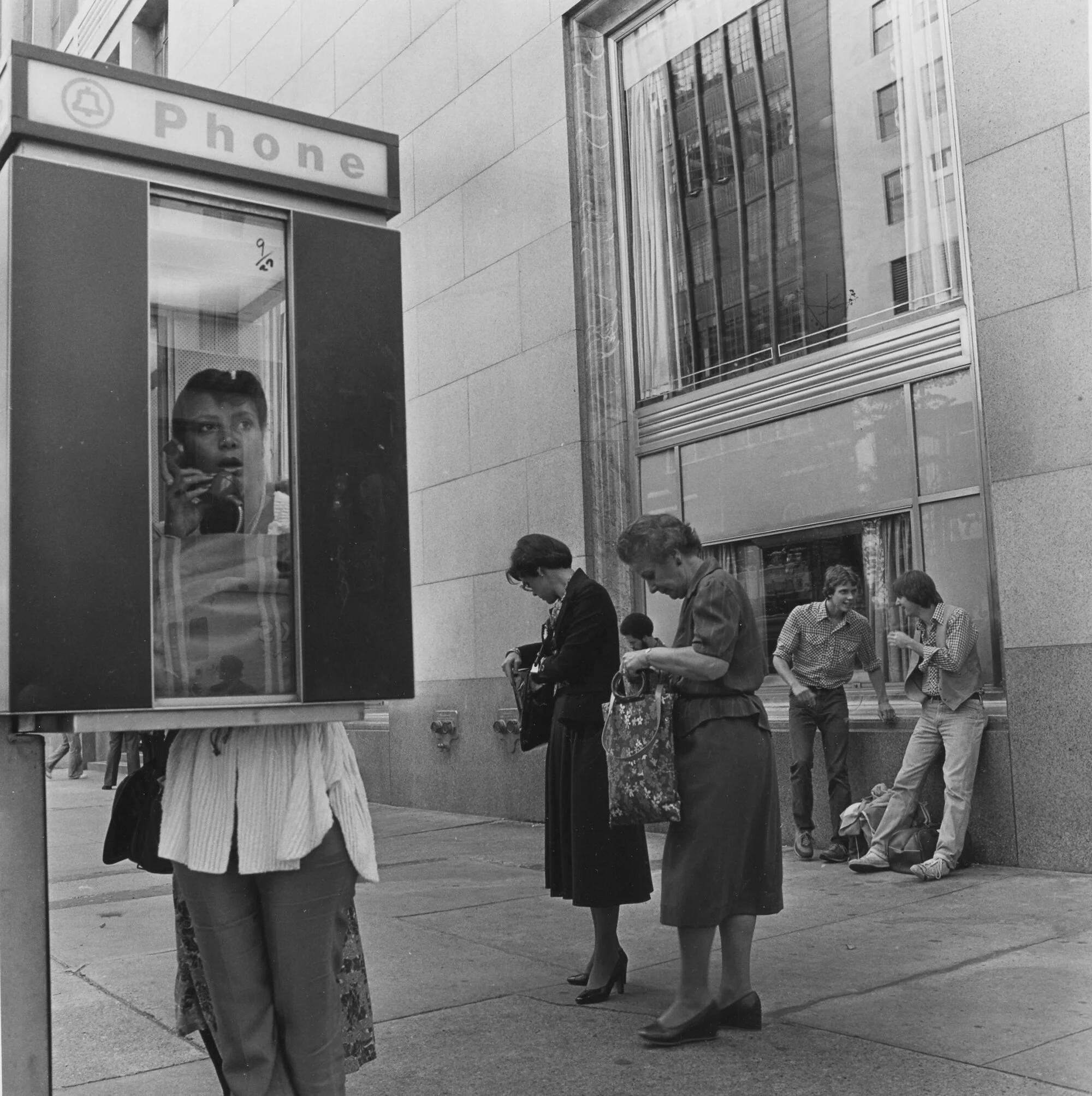
Morris Engel, Phone Booth, 57th Street- Two Women 1970’s.
Urban environments can be photographically represented in innumerable ways. Paris streets were daguerreotyped just weeks after the process was revealed. Most municipal tax offices hold identifying images of the structures they assess; nowadays, they are generally in color, snapped with a camera phone and intended as strictly indexical. The public areas of cities may serve simply as contextualizing backgrounds for photographic intentions as different as formal portraiture, architectural records, family snapshots, housing reform, and the sale of used cars, but they have proven to be worthy subjects in their own right and have established a genre in the art world. Loosely identified as street photography, such work is generally agreed to be candid, unstaged, unmanipulated images of things and people observed in public spaces. In the days before the ubiquitous mobile phone, public telephones were common in the photographed streetscape, most often simply as things of the city, along with sewer grates, fire hydrants, mailboxes, and traffic lights. Sometimes they were intentionally included in a photograph to signal a particular place, as ubiquitous red boxes once did in every tourist’s snapshot of London. Sometimes they served formally as a frame within a frame, to arrest, isolate, emphasize and shape bodies, emotions or gestures, as in Morris Engel’s 1970s New York City survey “A Time to Speak” which showed people tethered to one spot in public places, engrossed in private conversations with an invisible speaker.
Almost none of Kunsman’s images show people, and the few we see are blurred, obscured, or distant, obliviously co-existent with the phone and its environment. With a few exceptions, the photographs seem to depict Rochester’s grimmest neighborhoods: a bleak cacophony of abandoned storefronts, admonitory signs (No Hanging Out, No Drugs, No Parking, “We’re Watching Your Speed”) and the graffiti, litter, and broken windows of giving up and being given up on. Even in the more affluent suburbs and gentrified parts of town, the places where Kunsman finds public telephones feel desolate, impersonal, and unclaimed in a somehow very American way, peculiar perhaps to our car culture, transience and urges to forget. Furthermore, this project is about Rochester, after all, so there is the looming surveillance of the Kodak Building, and snow, usually showing no footprints around a phone rarely used. Often, it seems, public telephones are located at gas stations, or next to mailboxes, trash receptacles and ATMs. They seem to persist in empty shopping malls and factories. In restaurants, they blend in with other décor of the 1970s.
Although Kunsman most often photographs public telephones in unpopulated spaces and moments, he is adept at implying their users and hinting at their narratives. A semi-enclosed phone crammed with take-out trash from multiple fast food outlets manifests both use and disregard. A free-standing sidewalk-mounted phone of the partially enclosed type is flanked by three shabby overstuffed armchairs, creating an extension of a living room in which we can imagine lively and relaxed conversations, and brash ownership of turf. In contrast, the empty cafeteria of a downsized Kodak plant is spare and sterile, the tightly ranked empty plastic chairs and silent phone on the concrete block wall suggesting talk that will not come again. Even the presence of absence is reflected in a public phone covered in vines like the temples of Angor Wat, and the pentimento of a distinctive rectangle outlined in dirt on a brewery wall, surrounded by scribbled phone numbers for the union, the lotto, and the community health center.
In addition to the wide varieties of content and contexts, photographic artists today may choose among a daunting range of styles, processes and formats; Kunsman’s choices have shaped the visuality (and meaning) of Felicific Calculus in a way that is intentional, telling, and effective. That the work is made on film is both conceptual and pragmatic. Film reminds us of the failure of Kodak, long the city’s largest employer, to address its own racism and that of the city it created, but it also demonstrates the noblesse oblige of Kodak’s limited support of this contemporary project through a modest donation of anachronistic materials, as well as Kunsman’s practical decision to solicit and use them. The images themselves are rendered in black and white, a decision that underscores their seriousness and links them to the earlier styles of the great picture magazines. Outside of the informational and activist contexts Kunsman has created here, these images could be easily placed in a number of photographic art genres, a fact that inevitably affects our response to them. Their rough and broken urban settings evoke the socially and politically motivated 1930s records typified by Aaron Siskind’s Harlem Document. Some, in their coolness, suggest the 1970s “styleless style” of New Topographics. The role of the telephone as the initiating factor of the photograph itself, reminds us of John Divola’s 1990s conceptual projects Isolated Houses, and Stray Dogs. Divola has termed these “automatic landscapes,” in that the conditions he has set for a group of photographs requires that a specified thing occurs in every image, resulting in a randomly generated depiction of whatever environment surrounds it.
The idea of photographic documentary in the United States came into its own in the 1930s, when it was eagerly embraced by the progressive activists of The Photo League, and utilized to publicize New Deal programs and the need for them by the photographers of the Farm Security Administration. The important Depression-era critic, Elizabeth McCausland defined documentary as “an application of photography direct and realistic, dedicated to the profound and sober chronicling of the external world.” Photographers as different as Lewis Hine, Dorothea Lange, Marion Post Wolcott, Aaron Siskind, and Paul Strand employed their craft in support of labor, housing reform, racial justice, and anti-fascism. In addition to its purpose, this kind of photography also had a distinctive look. It was generally black and white due to the technical and economic limitations of the times, and it was sharp, carefully focused and direct, at least in part as a rejection of the sentimental softness of Pictorialism. The look also suited the tenets of modernism being promoted by Beaumont Newhall and the Museum of Modern Art. Precise, urban, straight and mechanical, it looked and felt like the kind of art they championed. It was Walker Evans who advanced the notion of “documentary style,” as a way of defining photographic art that was significant precisely because it was not intended to be useful, or to have any meaning outside the frame. This approach to photographing the external world has dominated art practice since the 1950’s, exacerbated by the Cold War association of social documentary with Communist sympathies, and the rise, in reaction to it, of what Ansel Adams called “creative photography.”
Felicific Calculus returns us to the kind of photographic content and intention that has its roots in the persistent progressive belief that shining light on the things that should be changed can actually change them. Kunsman’s richly detailed images are well crafted, carefully sequenced, and composed to catch and hold the eye; they linger in a way that other descriptions do not. Nevertheless, their purpose is not to delight, although they do, but to investigate, document and witness, to support the kinds of analysis usually left to sociologists and geographers, and encourage the kinds of actions that matter at the level of individual lives. Like the legendary Pittsburgh Survey of more than 100 years ago, these photographs, and the maps and other information that informs them, describe a city in order to improve it. Felicific Calculus may change the way the way we see poverty’s landscape, or at least the tiny element of it that is the public telephone. It is possible that this project and the ongoing efforts of Kunsman and others will help to keep some of these phones operational in the neighborhoods where they are needed. W. Eugene Smith spoke of his work giving voice to those who don’t have one. Perhaps this voice will come over the phone.
*Morris Engel photographs used with permission. Copyright Morris Engel - Orkin/Engel Film and Photo Archive.
Felicific Calculus: A Tale of Two Cities
Benjamin Hickey, Curator of Exhibitions, Hilliard Art Museum
Benjamin Hickey, Curator of Exhibitions, Hilliard Art Museum. The casual rivalry between Buffalo and Rochester may obscure the universal relevance of a Rochester-centric exhibition on view at CEPA Gallery in Buffalo, NY. Generally, the rivalry between Buffalo and Rochester is imagined and pursued for comic effect, but there is truth in humor. The lazy derision with which the citizens of each city treat each other is a troubling parable for society that needs to be addressed to better highlight how crumbling infrastructure affects those who are most vulnerable. Within the context of Felicific Calculus: Technology as a Social Marker of Race, Class & Economics in Rochester, NY there is a real danger of externalizing the issues Eric T. Kunsman’s work explores as being something Rochester is dealing with. Kunsman’s black and white photographs of Rochester give Felicific Calculus a timeless quality that make them seem clinical or scientific to contemporary eyes. This is a purposeful and effective choice for analyzing the cultural and sociological impact of payphones within a community. It also reveals that this essay’s title Felicific Calculus: A Tale of Two Cities refers less to Buffalo and Rochester, but to society in general and the social stratification that exists within it. Access to telephones, a central concern within Kunsman’s work, is a systemic social justice issue that is poorly understood by most. I would propose that the largely privileged visitors to this exhibition or readers of this publication would be none the wiser, myself included, if the title of the exhibition ended with in Buffalo, NY. Most art audiences just do not live in neighborhoods that rely on payphones.
The direct, unflinching tone of this text is inspired by Louis Draper’s leadership of the Kamoinge Workshop. Draper was the spiritual leader of the workshop, a collective of socially conscious African American photographers who famously and, at times, harshly critiqued each other’s work and American society. In 2020, the Virginia Museum of Fine Arts presented the exhibition Working Together: Louis Draper and the Kamoinge Workshop; the exhibition then traveled to the Whitney Museum of American Art. This is worthy of mention because Draper served as Kunsman’s mentor, deeply influencing his development as a photographer. Professionally, Draper provided Kunsman with a timely exhibition opportunity shortly before his death. The exhibition paved the way for Kunsman to serve as Draper’s successor as head of the Photography Department at Mercer Community College. Additionally, Draper’s intellectual impact on Kunsman can be brought into focus when considering the Kamoinge Workshop’s goals. The meaning of the word kamoinge is, “a group of people acting together” in the Kikuyu language found in Kenya. As a result, society as a collective means a great deal to Kunsman. His intention with respect to exhibiting his work is a call to action as well as an analysis. Collaborators are welcome, action is anticipated.
With the collective in mind, consider how repetition legitimizes. Once a norm is accepted and repeated it self-perpetuates. In the 1980s and 1990s before cell phones permeated society, there was a broad movement to do away with payphones because politicians and members of the media associated them with drug dealers taking advantage of the legal difficulties related to wiretapping a public telephone line. Only rarely did public discourse present payphones as a lifeline between members of disadvantaged communities and crucial services. Accordingly, mischaracterizations about these communities and the proliferation of supposed criminal activities within them spiraled out of control further isolating them. Even in the twenty-first century when cell phones seem ubiquitous to most, they are not universal. Many still rely on payphones, but more and more of these once commonplace telephones are defunct, exacerbating the issues described above. It is a cycle that is speeding up and made worse by the fact that many decision-makers in government and business do not see payphones as a relevant means of communication.
If repetition does in fact legitimize, it is possible Kunsman’s work, and work by likeminded individuals, could build consensus around finding solutions for communities that need expanded communications infrastructure as well as other assistance. Much like payphones themselves can be manufactured in a serial manner, so can photographs. An edition of photographs can be printed, replicated, and exhibited so as to mirror the scale of the social impact represented by fewer and fewer payphones on those who rely on them. In the context of this exhibition and publication, the serial, repetitive nature of the images is subtly heartbreaking. The only hope for payphones actually being part of the solution lies in companies like Frontier Communications maintaining a dwindling number of payphones in Rochester regardless of whether they are financially lucrative. Unfortunately, most other communications companies treat payphones with ambivalence and often decommission these crucial lifelines. What then is the long-term solution?
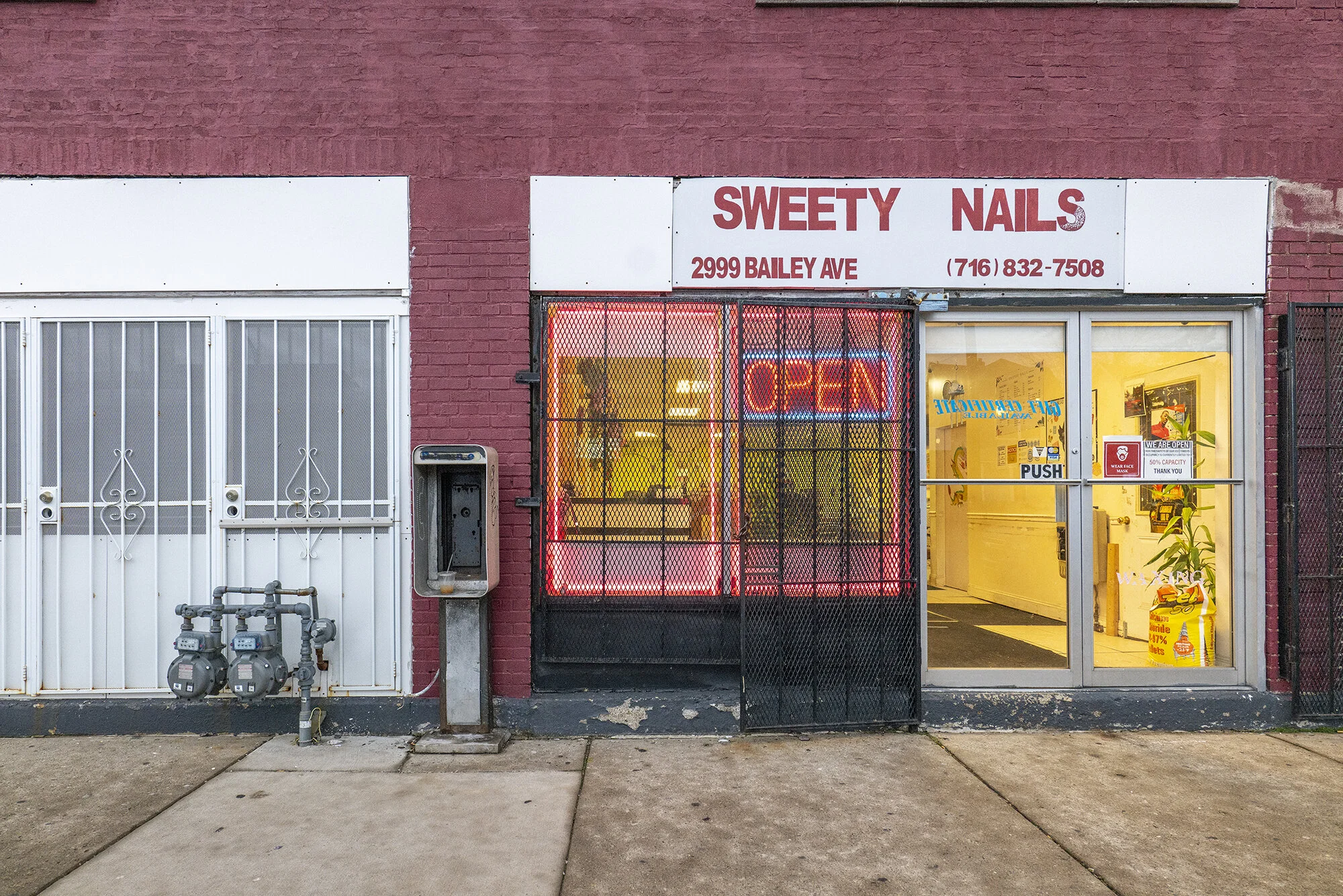
Sweety Nails- 2999 Bailey Avenue, Buffalo, NY
People will be the solution, but that is not heartening for Rochester or Buffalo. Unfortunately, the discourse surrounding Kunsman’s work is required, and like his project Felicific Calculus, must be ongoing. How effective will using Rochester as a case study with a universal feel be? I do not know. What I do know is, in a deeply rooted, historical sense, Buffalo is a racially and economically divided city. This was made patently clear by a report published in 2018 by the Partnership for the Public Good. Among the statistics that stood out in the report is a Buffalo-Niagara metropolitan area’s ranking as the sixth most segregated area in the nation. Even while stories boasting about Buffalo’s economic transcendence in this century abound, it is one of the most stratified and segregated metropolitan area in the United States. Combatting this trend is what is at stake in Felicific Calculus. The payphones in this series call into question the systemic, uncaring manner in which we as a society dole out inequity.
This was brought home to me by Kunsman’s vivid, full-color photograph of a nail salon at 2999 Bailey Avenue in Buffalo, NY. This photograph struck a chord with me because it is different from the black and white Rochester work. It also happens to be ten blocks from where I lived until I was twelve. After that, my family moved to the suburbs in the mid-1990s. From 1,300 miles away in Louisiana, and 28 years later, the image seemed to come from a time capsule. The more things change, the more they stay the same. I saw myself in Kunsman’s work and it was as powerful as it was unpleasant because it revealed how I am tied to Buffalo’s history of inequity. Let this be the beginning of something. Collaborators are welcome, action is anticipated.